What is a GTIN Code and How to Obtain It for Your Products
 GEDITOK
1. What Exactly is a GTIN?
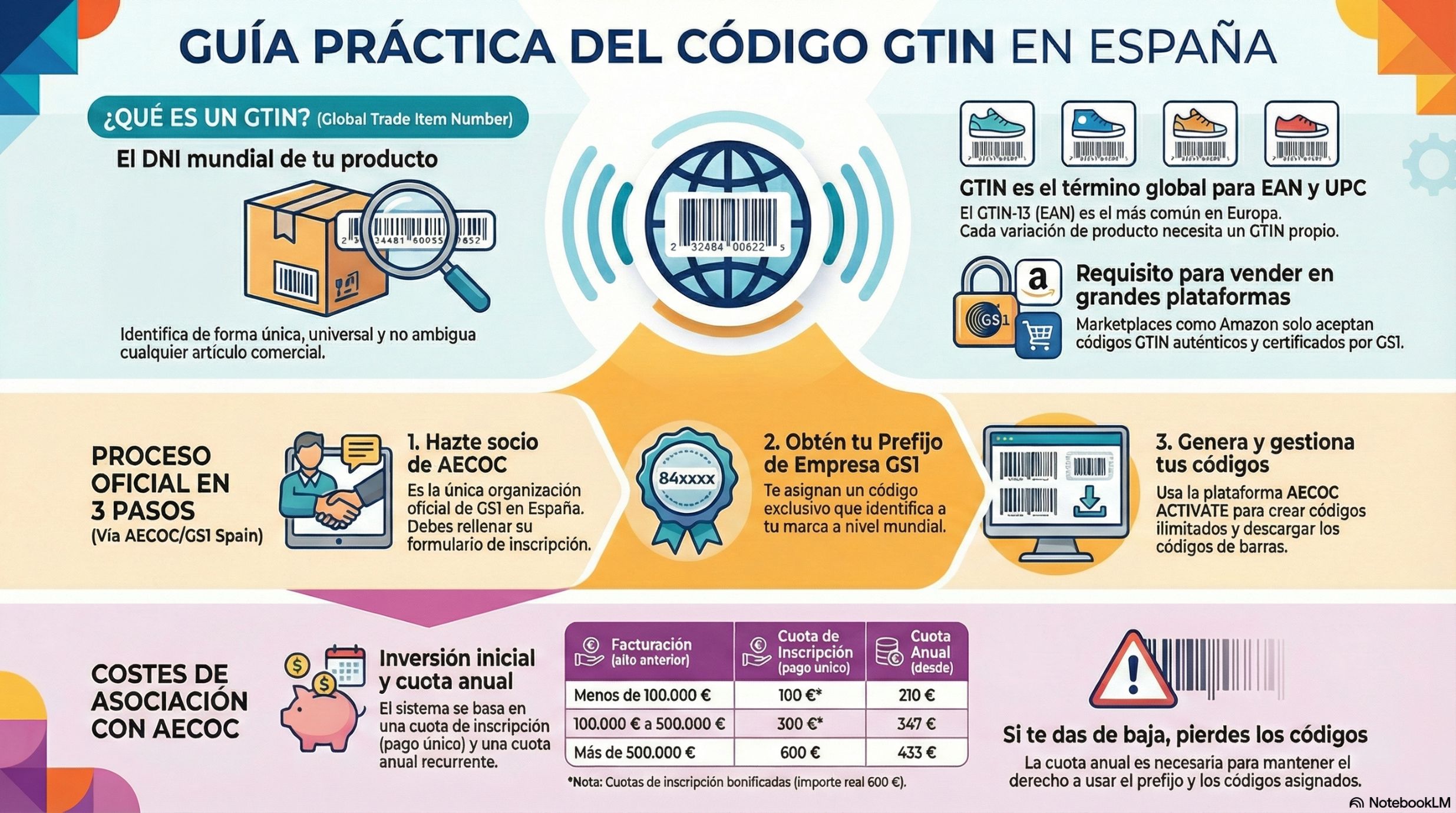
The Global Trade Item Number (GTIN®) is the globally unique identification number of the GS1 system. Its function is to identify trade items, which according to GS1 definition are:
"Any product or service that can be priced, ordered or invoiced at any point in the supply chain."
The GTIN is the foundation of the GS1 system (formerly known as the EAN/UCC system) and can have a length of 8, 12, 13 or 14 digits. This flexibility allows adaptation to different types of products, packaging, and sector regulations worldwide.
2. Who is Responsible for Assigning a GTIN?
The responsibility for assigning a GTIN falls on the Brand Owner. This is the organization that owns the item specifications, regardless of where or by whom it is manufactured.
According to GS1 regulations, the Brand Owner is usually:
- The manufacturer or supplier: when manufacturing an item (or commissioning its manufacture) and marketing it under their own brand.
- The importer or wholesaler: if commissioning the manufacture of an item to sell under their own brand, or if modifying an existing product significantly (for example, changing its packaging).
- The retailer: when commissioning the manufacture of an item to sell under their private label or store brand.
Important Exception
In the case of unbranded or generic items (for example, unpackaged fruit or screws), the responsibility for assigning the GTIN falls on the manufacturer, as there is no brand owner in the traditional sense.
3. Step-by-Step Guide to Obtaining a GTIN
The process for obtaining a GTIN is structured and managed through the global GS1 network.
Step 1: Contact Your Local GS1 Organization
GS1 operates as a federated network with 112 Member Organizations (MO) in 112 countries. Any company can apply for membership in their local organization to start using the GS1 system.
Step 2: Apply for Membership and Estimate Your Needs
You must estimate how many GTIN codes you will need, considering:
- Different products
- Variants (sizes, colors, flavors, formats, etc.)
Each variant requires a unique GTIN. Once the estimate is made, the membership form is completed and the license terms are accepted.
Step 3: Pay License Fees
Each GS1 Member Organization operates on a not-for-profit basis and sets its fees locally. These usually depend on:
- Number of GTINs needed
- Company size
- Revenue volume
Step 4: Receive Your GS1 Company Prefix and Assign Your GTINs
Once the process is approved, the company receives a GS1 Company Prefix, a globally unique number that identifies your organization.
This prefix is the root for generating all your identifiers, including GTINs. The complete GTIN is constructed by combining:
- GS1 Company Prefix
- Internal item reference
- Check digit
The prefix is exclusive, non-transferable and cannot be reused by other companies.
4. Key Rules: When Do You Need to Assign a New GTIN?
The general principle is clear:
If the customer distinguishes a new item from an old one and purchases accordingly, a new GTIN must be assigned.
Cases that DO require a new GTIN
Changes in Basic Characteristics
- Change of name or brand
- Change of variety (flavor, color, fragrance)
- Change in net quantity (weight, volume, units)
Significant Logistical Changes
- Change greater than 20% in gross dimensions or weight
Promotional Variants
- "10% extra free"
- Price marked on package
- Seasonal packaging (Christmas, Easter, etc.)
Cases that DO NOT usually require a new GTIN
- Minor design or labeling changes
- Logistical changes less than 20%
- External promotions (coupons, sweepstakes, contests)
5. Conclusion
The GTIN is not just a number under a barcode: it is the global standard that enables efficient and accurate trade on a worldwide scale. Obtaining it through GS1 allows companies to identify, differentiate and manage their products in an interoperable manner and in accordance with international standards.
Correctly applying assignment rules ensures a more efficient, accurate and reliable supply chain. Ultimately, the correct use of GTINs is an essential practice to enable frictionless trade in a global and increasingly regulated market.