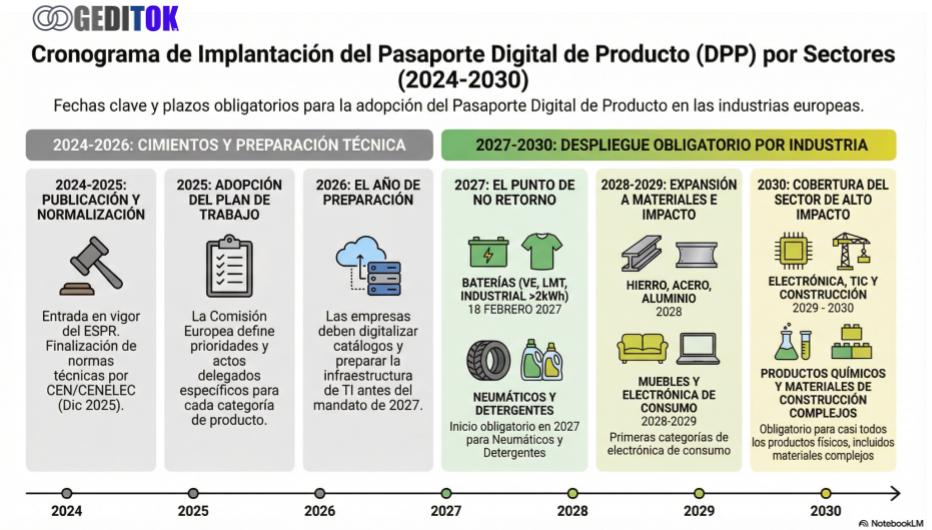
Digital Product Passport (DPP) Calendar: Sectoral Roadmap (2024-2030)
 GEDITOK
The rollout will not be simultaneous for all. It will be governed by a staggered calendar defined by the Ecodesign for Sustainable Products Regulation (ESPR), which came into force on July 18, 2024. Based on this framework, the European Commission will approve specific delegated acts that will activate the obligations for each sector.
The following is a detailed schedule of implementation based on current regulations and expert projections.
1. The General Framework: The Foundations (2024-2026)
Before the arrival of sectoral passports, the legal and technical bases must be established:
- July 2024: Entry into force of the ESPR Regulation (2024/1781). This regulation repeals the old ecodesign directive and establishes the general framework for the DPP.
- First half of 2025 (Forecast: April): The European Commission will adopt the first ESPR Work Plan for the period 2025-2030. This document will confirm the definitive list of priority products.
- End of 2025: Deadline for standardization bodies (CEN/CENELEC) to deliver harmonized standards on the DPP system (unique identifiers, data carriers, interoperability).
- 2026: The publication of the first Delegated Acts (specific rules) for priority sectors such as textiles and steel is expected. Generally, there is a transition period of 18 months from the publication of the act to its mandatory application.
2. Implementation Schedule by Sectors
🔋 Batteries: The Pioneer (Confirmed Date: February 18, 2027)
This is the only sector that already has its own approved regulation (EU Regulation 2023/1542) and firm dates, serving as a "pilot" for the rest.
- Mandatory Date: February 18, 2027.
- Scope: Electric vehicle batteries (EV), industrial rechargeable batteries (>2 kWh), and light means of transport batteries (LMT).
- Content: It must include data on the carbon footprint, recycled content, performance, durability, and battery chemistry.
- Exception: Portable batteries do not require a complete passport, but a QR code with basic information is required.
👕 Textile and Fashion: The First Wave of ESPR (Mid-2027)
The textile sector is an absolute priority due to its environmental impact and low recycling rates.
- Regulation: The specific Delegated Act is expected to be published in early 2026.
- Implementation: Considering the transition period, the DPP would be mandatory towards mid-2027.
- Key Data: Fiber traceability, substances of concern, reparability, and recycled content. Identifiers (such as QR codes) must be physically accessible on the product.
🏗️ Construction: A Custom Calendar (2027-2030)
This sector is governed by the new Construction Products Regulation (CPR), approved at the end of 2024.
- Preparation Phase: Begins in 2026.
- Mandatory Date: It will be implemented in phases starting from 2027 for priority product families with a higher environmental footprint (cement, insulation, etc.).
- Full Deployment: It is expected to reach most products in the sector by 2029-2030.
🔩 Intermediate Materials: Iron, Steel, and Aluminum (2027-2028)
They are fundamental to decarbonizing the European industry and are listed as priorities in the first work plan.
- Iron and Steel: The publication of their technical regulation is expected in 2026, with an estimated entry into force for 2027 or 2028. The Joint Research Centre (JRC) is already working on preparatory studies.
- Aluminum: Its regulation will closely follow that of steel, with an implementation likely in 2028.
💻 Electronics and ICT (2028-2030)
Although it is a priority, the complexity of its components suggests a later implementation than textiles.
- Estimated Calendar: Projections place the mandatory obligation between 2028 and 2029, with some scenarios projecting full deployment towards 2030.
- Previous Advances: Repairability and durability requirements will be applied beforehand under existing ecodesign regulations (e.g., smartphones and tablets).
🛋️ Other Priority Products (2027 and Beyond)
ESPR has pre-identified other groups that will follow the first wave. Requirements are expected from 2027-2028:
- Furniture and Mattresses: Forecast for 2027-2029.
- Tires: Requirements expected from 2027.
- Chemical Products (Detergents, Paints, Lubricants): Listed in the work plan for the period 2027-2030.
Chronological Summary of Milestones
| Year | Key Milestone / Sector | Detail / Status |
|---|---|---|
| 2024 | ESPR Entry into Force | Legal framework active since July 18. |
| 2025 | ESPR Work Plan | Official adoption of the list of priority products (Q1-Q2). |
| 2025 | Technical Standards | Completion of CEN/CENELEC standards on the DPP system. |
| 2026 | Delegated Acts | Expected publication of rules for Textile and Iron/Steel. |
| Feb 2027 | BATTERIES | Mandatory for EV, LMT, and industrial >2kWh. |
| 2027 | TEXTILE AND FOOTWEAR | Estimated entry into force of the mandatory DPP. |
| 2027 | CONSTRUCTION | Start of mandatory implementation for priority materials. |
| 2027-28 | FURNITURE / TIRES | Estimated implementation window. |
| 2028 | IRON, STEEL, ALUMINUM | Estimated entry into force for intermediate materials. |
| 2028-30 | ELECTRONICS | Mandatory implementation window. |
What Should Companies Do Now?
Although for many sectors the legal obligation seems distant (2027), experts recommend acting now. The technological deployment and data collection in the supply chain are complex processes.
- Digitalization: Companies must prepare to connect sustainability, origin, and compliance data in an interoperable format.
- Transition: There is an adaptation period of 18 to 24 months from the publication of the technical regulation (Delegated Act) until its entry into force.
- Impact: Non-compliance will mean the impossibility of marketing products in the EU market ("No passport, no market access").